
Abstract
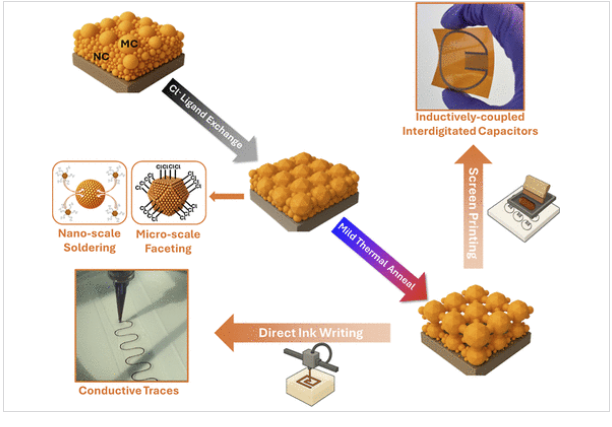
We report the formulation and printing of Cu inks composed of binary mixtures of colloidal ∼5 nm Cu nanocrystals (NCs) and ∼500 nm Cu microcrystals (MCs) and postdeposition chemical and low-temperature thermal treatments to achieve micron-thick, high-conductivity metal traces that yield high-performance, printed radio frequency (RF) electronic devices. Solid-state NH4Cl treatment of binary Cu NC/MC mixed films removes insulating ligands and surface oxides and establishes Cl–-mediated surface chemistry that drives NC-enabled “nano-soldering” between MCs and increased MC faceting and interparticle necking. Subsequent mild annealing under N2 promotes further densification to yield micron-scale films with resistivities as low as ∼14.5 times that of bulk Cu for optimized 75 wt % NC/MC films after annealing at 150 °C for 5 min. By formulating these binary NC/MC systems in α-terpineol/ethyl cellulose/poly(vinylpyrrolidone) vehicles, we obtain non-Newtonian inks compatible with both screen printing and direct ink writing (DIW) and we deposit micron-thick patterned conductive traces on flexible substrates. Screen-printed, flexible RF inductively coupled interdigitated capacitors are fabricated from the mixed NC/MC inks and achieve Q = 4.89, corresponding to ∼68% of a bulk-Cu reference. DIW produces over 100 μm thick CAD-defined traces with an average resistivity of 95 ± 22.6 μΩ·cm. We show that NC-enabled processing of mixed NC/MC systems yield manufacturable, high-frequency metal components for printed Internet of Things platforms.
https://iopscience.iop.org/article/10.1088/2058-8585/ae57bc
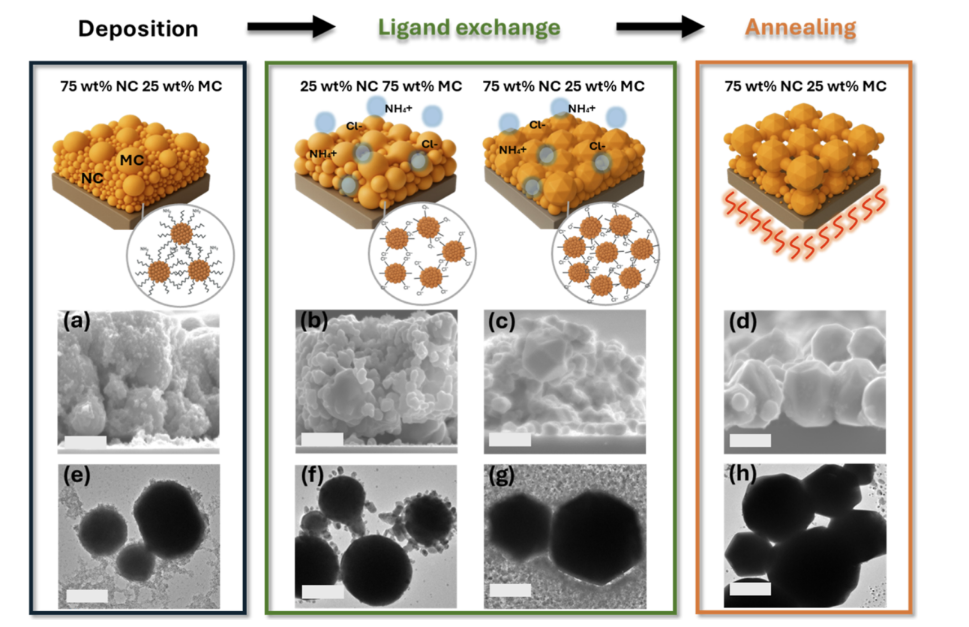
Figure 1. Schematic and (a−d) scanning and (e−h) transmission electron microscopy images following the chemical and thermal sintering of binary 5 nm diameter, oleylamine capped Cu NC and 500 nm diameter, Cu MC mixed films (black box) upon ligand exchange with methanolic NH4Cl solutions (green box) and annealing at 150 °C (orange box). Scale bar: 500 nm.