
Abstract
Polarization diversity offers a cost- and space-efficient solution to enhance the performance of integrated sensing and communication systems. Polarimetric sensing exploits the signal’s polarity to extract details about the target such as shape, pose, and material composition. From a communication perspective, polarization diversity can enhance the reliability and throughput of communication channels. This paper proposes an integrated polarimetric sensing and communication (IPSAC) system that jointly conducts polarimetric sensing and communications. We study the use of single-port polarization-reconfigurable antennas to adapt to channel depolarization effects, without the need for separate RF chains for each polarization. We address two core sensing tasks in IPSAC systems, target parameter estimation and target detection. For parameter estimation, we consider the problem of minimizing the mean square error (MSE) of the target depolarization parameter estimate, which is a critical task for various polarimetric radar applications such as rainfall forecasting, vegetation identification, and target classification. To address this nonconvex problem, we apply semi-definite relaxation (SDR) and majorization-minimization (MM) optimization techniques. Next, we consider a design that maximizes the target signal-to-interference-plus-noise ratio (SINR) leveraging prior knowledge of the target and clutter depolarization statistics to enhance the target detection performance. To tackle this problem, we modify the solution developed for MSE minimization subject to the same quality-of-service (QoS) constraints. Extensive simulations show that the proposed polarization reconfiguration method substantially improves the depolarization parameter MSE. Furthermore, the proposed method considerably boosts the target SINR due to polarization diversity, particularly in cluttered environments.
https://ieeexplore.ieee.org/document/11358846
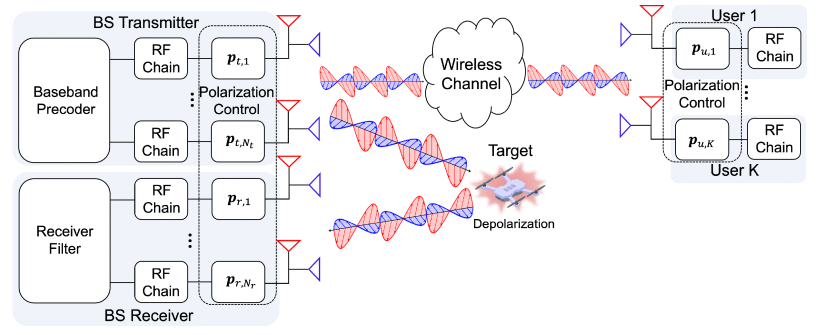
Fig. 1.
ISAC system with polarization-reconfigurable arrays. Each antenna can adjust the linear polarizations of the transmitted and received signals. The transmitted wave experiences depolarization at the target, and the backscattered signal is received at the BS receiver.