

Abstract
Internet of things (IoT) systems rely on the broad deployment of electronic devices and sensors in diverse environments. In some applications, including agriculture, packaging, and medical, there is a need for devices with relatively short lifetimes. Thus, there is growing interest in bio-based substrates for printed electronics and sensors that improve sustainability and minimize the environmental impact of IoT devices. Paper is a natural choice as a substrate for disposable printed devices; however, the high surface roughness and porosity of typical papers lead to printed structures with high variability. Here, we report a nanocellulose-infiltrated paper consisting of a cellulose nanofibrils (CNFs) film supported on a cardstock substrate. The CNF solution was coated onto the cardstock and then press-dried to form a smooth and dense surface. The CNF partially infiltrates the substrate, but forms a distinct film on the surface. The CNF coating process reduced the root mean square surface roughness of the cardstock from 4.3 µm to 189 nm. This improvement in surface properties enables the screen-printing of silver patterns with geometric uniformity comparable to that of patterns printed on conventional polyimide substrates. The moisture sensitivity of these cellulose-based substrates can be exploited for moisture sensing, and the moisture absorption/desorption and resulting change in relative permittivity of these substrates are characterized.
https://iopscience.iop.org/article/10.1088/2058-8585/ae57bc
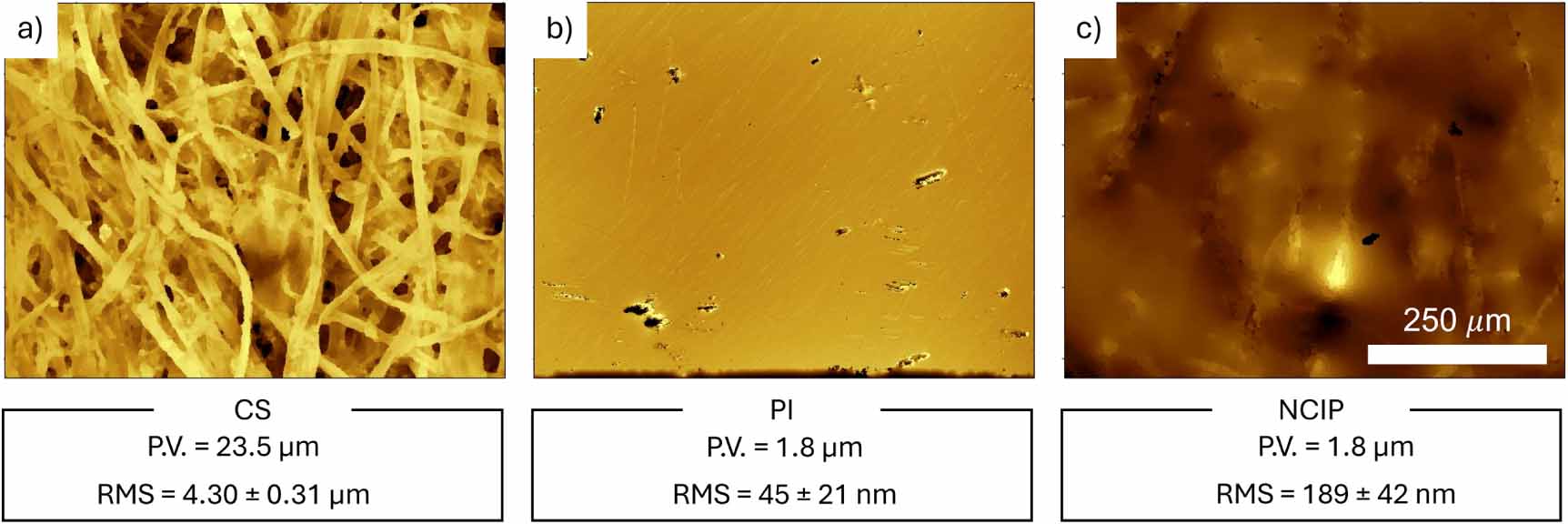
WLI images of the surfaces of (a) cardstock, (b) polyimide, and (c) nanocellulose infiltrated paper (NCIP) taken at 20x magnification. Peak to valley (P.V.) indicates the range of heights in each topography map. The average and standard deviation of the root mean square roughness (RMS) are indicated for each substrate (n = 25).